Get upto 30%* off on your First order

Get upto 30% off on your order
Are lab-grown diamonds ethical? On the conflict side, the answer is a clean and permanent yes. On the sustainability side, the honest answer is more complicated than the marketing usually admits: it is entirely dependent on the energy sources powering the facility that grew the stone, not just the growing vs. mining process. In the most literal sense, ethical diamonds have to be about openness on both sides of the issue, not just the positive side.
This closes out the series that started with our lab-grown vs natural diamonds guide and our 4Cs of diamonds guide, worth reading first for the fundamentals this piece builds on.
Conflict-Free: The Clear Part
This part is very simple. Lab-grown diamonds are grown in a controlled environment (not mined from the earth) and do not go through the same physical supply chain as conflict diamonds. The Kimberley Process is an international certification scheme which aims to ensure that conflict diamonds do not enter the legitimate diamond market. The Kimberley Process is largely focused on oversight of mined gemstones. Since a laboratory-grown diamond does not have a mining provenance, the term conflict-free diamonds is an accurate and permanent description rather than just a marketing gimmick.
The energy issue discussed below is more complex, but lab-grown diamonds completely and unambiguously answer this part of the ethical diamond sourcing issue. No story about the creation of a lab-grown diamond, regardless of the facility or nation of production, includes the labour and conflict dangers associated with mined jewels.
The Energy Question: Why “Eco-Friendly” Isn’t a Given
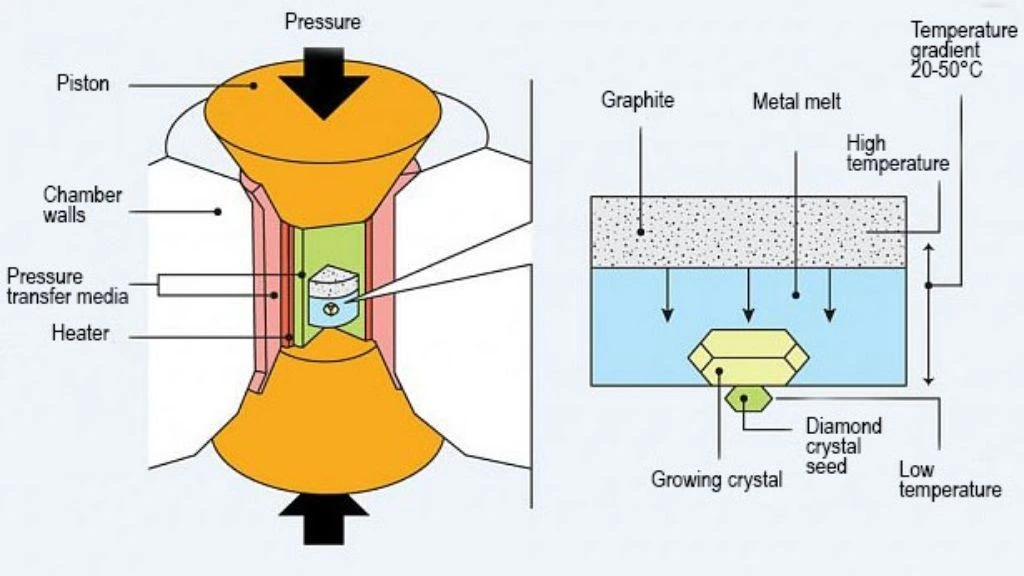
This is where most lab-grown diamond advertising gets too basic. The development of a diamond by HPHT or CVD is a process requiring a lot of electrical power, and it has to come from a certain source. The ecological argument for lab-created diamonds is a good one but contingent and not inherent, and the argument has been viewed as inherent; that is the very rationale that has been subject to regulatory scrutiny, detailed further below.
How Much Energy Does It Actually Take?
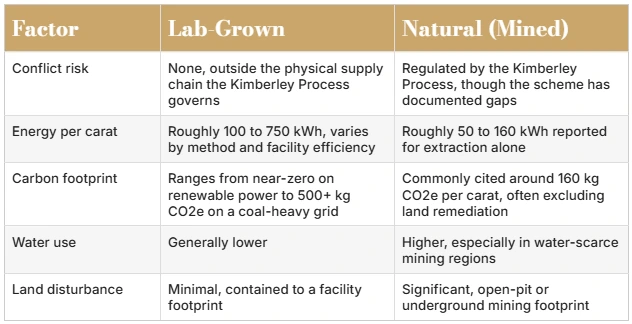
Published statistics depend on the technique and the operational efficiency of a particular plant, but a reasonable range is about 100 to 750 kWh per carat. CVD reactors generally are more efficient than HPHT presses, but efficiency varies widely depending on size and age of the reactor, and how well the facility recovers waste heat. The energy cost of natural diamond extraction is frequently quoted as being in the range of 50 to 160 kWh per carat. However, this usually does not include the wider cost of land disturbance and site restoration.
Where the Electricity Comes From Matters More Than the Process
750 kWh from the grid fuelled by coal has a lot more carbon emissions than 750 kWh from hydropower or solar. The reactor does not care where the electricity it consumes comes from; the emissions characteristics are simply a function of the upstream power source, not the cultivation technique. The carbon footprint of lab-grown diamonds is highly variable, from practically nothing in facilities running on renewable energy to over 500 kg CO2e per carat in countries that rely on coal, compared with the often cited 160 kg CO2e per carat for wild diamonds. The truth is, lab-grown diamonds aren’t automatically the greener option; it is dependent upon where they’re grown.
A single blanket statistic for the carbon footprint of lab-grown diamonds is largely meaningless until the power source is understood. Two stones that are grown to identical specifications in different facilities might have carbon footprints that vary by a factor of 10.
What “Ethical” Actually Means in the Jewelry Supply Chain
The word ethical diamonds is commonly used in a catch-all sense; however, it refers to many quite different issues that require independent responses: conflict provenance, labour conditions, and environmental impacts. Lab-grown diamonds completely solve the first problem. In a controlled manufacturing plant, labour conditions are generally more controllable and regulated than in a far-away mining site, although it is dependent on the specific facility and its labour practices, as with any manufacturing site. As shown above, the environmental impact is conditional rather than determined in one direction or another.
The phrase eco-friendly diamonds deserves some thought rather than a quick assumption. A diamond grown at a facility powered by renewable energy is truly deserving of such a certification. A plant grown on a grid that is coal-dependent does not, despite being grown instead of extracted.
What About India’s Grid?
Since Culture Carats sources from Surat, there is a need to address this issue face-to-face rather than avoiding it. More than 70 percent of global lab-grown diamond output is from facilities powered by coal-intensive energy sources, mostly in China and India. India’s renewable energy capacity has now crossed 50% of the total installed capacity, but capacity is not the same as output. Coal plants are more reliable than solar and wind, and coal will generate 70 to 75 percent of the power produced in India by 2026. That is the real number, not the more attractive capacity amount that sustainability marketing sometimes uses.
In reality, a lab-grown diamond that is cut and polished in India today carries a large carbon footprint from the electrical grid, even if the diamond itself did not require any mining. We want to make this transparent and not imply some level of environmental cleanliness that the existing grid does not currently provide. People asking if lab-grown diamonds are ethical, especially those from India, want a direct rather than a generic answer.
“We are really on the right trajectory, as India added its renewable capacity faster than most countries did in 2025 and 2026, and that share of actual generation will continue to grow.” We choose to declare this now, rather than retract it in the future, because a full eco-friendly assertion on India-sourced production has not yet been verified.
Where Lab-Grown Diamonds Win Cleanly
There are two areas that do not need a warning. In general, lab-grown diamonds use less water than mining, particularly in water-scarce places. The damage to the land is negligible: A synthetic diamond factory is a closed industrial building, while diamond mining can entail large open-pit or underground operations that can have a land impact that may take decades to restore, if it is restored at all. Lab-grown diamonds are clearly the better choice on both these issues, regardless of where the energy comes from.
If you want to know whether lab-grown diamonds are sustainable, it’s crucial to emphasise the importance of this difference rather than dissecting it into its components. Sustainability is a multi-parameter issue because lab-grown diamonds obviously excel at some criteria (water, land) but conditionally (carbon, depending on the energy source) at others. Most marketing on this topic falls short when it tries to distill all of that into a simple yes or no answer.
What the FTC Says About “Eco-Friendly” Claims
The FTC has warned certain companies in the lab-grown diamonds space in the past for making unsubstantiated green or sustainable claims. This is important for the way any shop, including ourselves, is allowed to talk about environmental impacts. It is the kind of blanket remark, such as lab-grown diamonds are excellent for the environment, without factoring in the impact of the energy source, that has to be examined. It is also simply less true than the real depiction, which is by definition more gripping: always without conflict and environmentally better only when the energy behind it really is.
Our Approach
We like to provide you the genuine reality, not a softer, more pleasant one. All diamonds we sell are conflict-free; no more explanation is necessary. From an environmental perspective, we won’t be making a sweeping sustainability benefit claim that the existing energy mix for lab-grown diamonds doesn’t fully support. Honestly, you have no mining, no land disturbance, no tailings, a supply chain that is far shorter than a mined diamond, and the energy piece is the only one that still deserves attention as grids move to renewables.
Lab-grown diamonds price in 2026 ->
FAQ
Are lab-grown diamonds ethical?
Yes, permanently, regarding the conflict element. Lab-grown diamonds do not enter the mined supply chain that the Kimberley Process was designed to oversee.
Are lab-grown diamonds sustainable?
It depends on the energy source as to what happens. Green-created diamonds are made with renewable energy and have a very low environmental impact. If the power comes from a coal-dependent grid, then the environmental footprint of the facility may be similar to that of mining.
Are lab-grown diamonds conflict-free?
Yes. They are grown in a facility, not mined, so they never enter the physical supply chain that conflict-free certification schemes were created to monitor.
What is the carbon footprint of a lab-grown diamond?
The emissions vary greatly, from very low emissions with renewable energy to over 500 kilograms of CO2e per carat on a coal-dependent grid, compared to the often cited 160 kg CO2e per carat for natural diamonds.
Are lab-grown diamonds eco-friendly?
Sometimes it is just a matter of the energy source that drives the output. The FTC has warned companies against making this claim without qualification, as it is not necessarily true.
Is India’s grid mostly coal or renewable?
Installed renewable energy capacity has crossed fifty percent of India’s total capacity; although coal still constitutes around 70 to 75 percent of the electricity generated as of 2026, owing to the more reliable performance of coal plants compared to solar and wind.
What does ethical actually mean for a diamond?
It deals with three different issues: causes of conflict, working conditions, and environmental impact. The lab-grown diamonds solve the first problem quite well and tend to do very well on the second. The third depends on the energy supply at that particular facility.
Why can’t lab-grown diamond sellers just say their diamonds are sustainable?
It is not intrinsically true. However, the FTC has warned companies against making such claims without qualification; a stone grown on a coal-intensive grid is not the same as one grown on renewable sources.