Get upto 30%* off on your First order

Get upto 30% off on your order
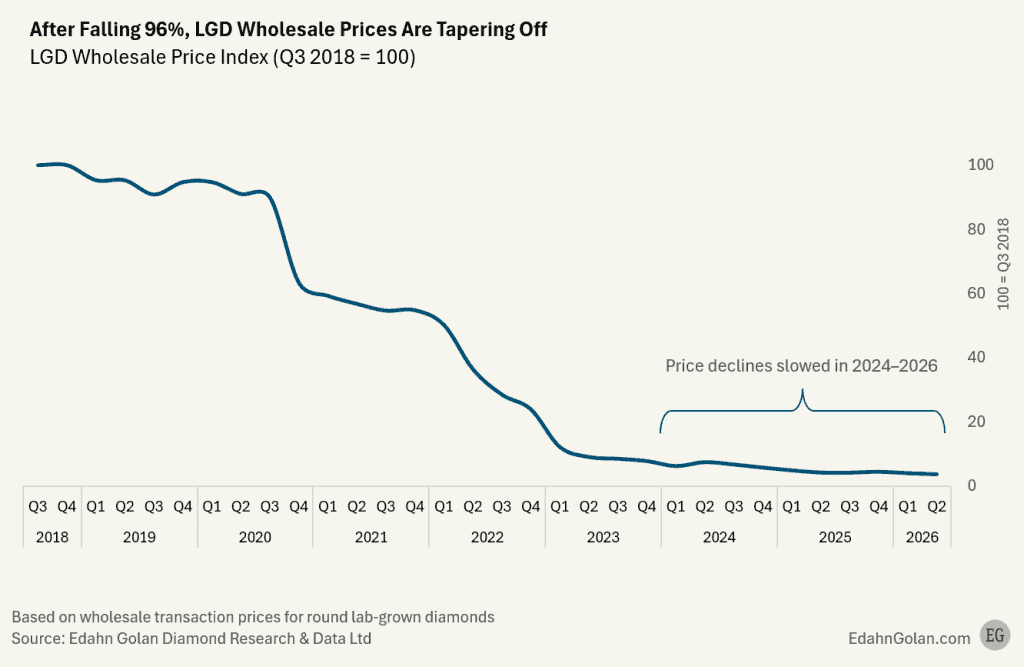
Lab-grown diamond prices have dropped at an unprecedented rate in the jewelry industry, dropping by about 96% since 2018 and still falling. This is the true information about lab-grown diamond prices and future stability, and no promotional hype if you want to understand the present relevance of lab-grown diamond pricing and future stability.
This guide builds on our lab-grown vs natural diamonds guide and our 4Cs of diamonds guide, worth reading first if you have not already.
What Lab-Grown Diamonds Actually Cost Right Now
According to industry-standard benchmarks, the cost of lab-grown diamonds is estimated to reach between $500 and $650 for a 1-carat gem, $1,100 to $1,300 for a 2-carat gem, and $2,300 to $2,600 for a 5-carat gem by mid-2026. The cut, hue, clarity, and certification of any individual gemstone will considerably impact the exact price, so use these as a guide rather than a specific price for a single diamond.
Two gemstones of the same carat weight might be priced very differently, depending on the quality of the cut and certification. A diamond with an Excellent cut and a full IGI grading report will typically be more expensive than a diamond with a Good cut and a generic GIA classification at the same carat weight, because more of the price is backed up by paperwork.
Why Prices Fell 96 Percent Since 2018
The discount is not a limited-time sale or promotional event. It represents a real structural change. Production technologies for CVD and HPHT matured and spread across the globe. The price of growing a diamond dropped significantly, and competition between an increasing number of producers drove the prices down to the new, lower production cost. It’s more like the price drops you see on flat-screen TVs or solar panels, not a typical jewelry sale. The cost of manufacture dropped, thus the price dropped with it.
This is the way to go for a 1-carat gemstone of a better quality, as checked through many industry references. The tendency is pretty much the same across carat weights, but larger jewels have traditionally been subject to higher premiums and more room for depreciation.
Is the Price Drop Slowing Down?
Yes. And on an irregular basis. Wholesale prices fell almost 26 percent in 2005, followed by a 14 percent decline in the first quarter of 2006 and a further 13 percent decline in the second quarter, which indicated a significant slowdown. The deceleration, however, is not uniform in the various dimensions. Wholesale prices for 1-carat round stones rose somewhat in the second quarter of 2026, suggesting the size is probably nearing a minimal production cost. Larger stones have lagged: diamonds of 1.5 to 2 carats fell 11 to 20 percent a year in the same period. If you are buying at the lower end of the market, costs may be more stable than for larger stones. If you are making significant purchases, there may still be room for a decline.
The Resale Reality
Here’s the real story on the resale value of lab-grown diamonds. Buying a lab-created diamond may result in a resale value of 20 to 40 percent of the initial purchase, assuming a buyer can be found. Many jewelers don’t buy back lab-grown diamonds at all, because a new one similar to the used diamond is often available for less than the price the used diamond would have to sell for. The jewelers who do buybacks typically value based on current replacement cost rather than what you originally paid, compounding the effect of lower pricing on resale.
This is not unique to lab-grown diamonds; natural diamonds are also not good investment possibilities when you include the retail markup, and lab-grown diamonds are even worse investments because their replacement cost is dropping. This matters a lot less if you plan to wear the thing and get enjoyment out of it than if you plan to get value back down the road. To have a more realistic expectation, if people want to know how much lab-grown diamonds are worth for resale, they should go into the conversation with that number, not the original retail price, in mind.
What Actually Affects a Lab-Grown Diamond’s Price
Lab-grown diamond prices are fluctuating as the market for these stones declines. Understanding why this is happening will help you be a smarter shopper rather than only looking for the best price you can find.
- Carat weight: The price does not scale linearly. Bigger gemstones still sell for a disproportionately higher price per carat, even in a falling market.
- Cut quality: The value of a cut stone is largely dependent upon its quality, and a nicely cut stone is worth more than a poorly cut stone of the same color and clarity.
- Color and clarity: In October 2025, GIA moved to Premium and Standard levels, changing how color and clarity information is reported. Now, how color and clarity are reported depends on the certifying laboratory. See our IGI vs. GIA guide to learn more.
- Growth method: HPHT-grown diamonds usually sell for cheaper than CVD-grown stones of the same quality.
- Certification lab: An in-depth IGI report and a tiered GIA report can have different pricing even if they have the same underlying quality, because buyers are willing to pay more for more accurate information.
One Thing That Could Push Prices Back Up: The 2026 Tariff Change
Most of this guide describes a long decline, although a recent event might reverse this trend, especially for stones from India. Under the temporary trade deal between the U.S. and India, signed in February 2026, the duty on loose natural diamonds and gemstones imported from India was eliminated. It didn’t apply to lab-grown diamonds not set in jewelry, which are still subject to an 18 percent tax, down from a wartime high of 50 percent, but still a high cost that hadn’t been figured into the price before.
India processes a large share of the world’s lab-grown diamonds, and the duty adds to the financial burden when wholesale prices were nearing a production limit. It creates a strange situation: the base cost of manufacturing a lab-grown diamond continues to drop, but the cost of bringing a finished stone into the United States has a new floor that wasn’t there a year before.
That could take the form of higher retail pricing, worse profit margins for vendors, or a combination of the two as trade policy continues to be determined. It’s a real variable on the future direction of lab-grown diamond prices, no guarantee either way, and worth keeping an eye on if you are deliberately timing a buy by price.
How to Think About Value When You’re Not Buying an Investment
Most people are not buying diamonds as an investment; they are buying them for what they mean. Viewed this way, the falling price of a lab-grown diamond is a good thing: you’re getting a bigger stone or the same stone for less money than a buyer would have spent a few years ago. For most, the true value of a lab-grown diamond comes in its appearance on the hand and what they represent, not in what it may be worth down the road.
The maths is disturbing only if you expect the diamond to appreciate or to have resale value, as sometimes people do with real estate or gold. It probably won’t. And if you go in with this idea firmly in mind, it prevents future disillusionment. If your idea of worth is to purchase the largest, finest cut, and most well-documented gemstone inside your current budget, then dropping costs are totally beneficial for you.
What This Means If You’re Comparison Shopping
Also, judging lab-grown diamonds merely on price can be misleading. A lower price might mean a worse cut quality or a generic GIA grade instead of a better bargain than a full IGI grade. It’s not best to compare only price. A better comparison is price versus the specific cut, color, clarity, and certification information that you obtain. If you look closely, two stones priced identically per carat as lab-grown diamonds can be very different purchases.
FAQ
How much does a lab-grown diamond cost per carat in 2026?
A 1-carat gem of outstanding grade will cost between $500 and $650 based on mid-2026 market criteria, depending on the cut, color, clarity, and certification.
Why are lab-grown diamond prices dropping so fast?
Wholesale prices have fallen by roughly 96 percent since 2018, driven by increased efficiency in CVD and HPHT manufacturing and a rise in the number of manufacturers, suggesting a fundamental shift rather than a one-time reduction.
Will lab-grown diamond prices keep falling?
Growth rates had slowed by mid-2026 to about 13 percent each year, with some sizes, including 1-carat rounds, beginning to plateau. More substantial stones are still falling at a faster rate. Likewise, a shift in tariffs on lab-grown diamonds imported from India in 2026 might push costs higher irrespective of production trends.
Do lab-grown diamonds hold their value?
Not well. In general, the resale value is 20 to 40 percent of the original purchase price and many jewelers would not buy back a lab-grown diamond.
What is the resale value of a lab-grown diamond?
Expect roughly 20 to 40 percent of what you paid, priced against current replacement cost rather than your original purchase price.
Are lab-grown diamonds worth it if prices keep falling?
For most buyers, yes, since falling prices mean more stone for the same budget. But the problem is, only if you think of the diamond as an investment that will hold its value, which is the opposite of what the falling price implies.
Could tariffs make lab-grown diamonds more expensive?
Possibly. The U.S. presently imposes an 18 percent levy on lab-grown diamonds coming from India, but natural diamonds enter the country tariff-free under the same trade pact that is set to expire in 2026. This can offset some of the continued price reductions that come from production.