Get upto 30%* off on your First order

Get upto 30% off on your order
Lab Grown vs. Natural Diamonds: What’s Actually Different
Lab grown vs natural diamonds? A lab grown diamond and a natural diamond are created from the same material: carbon, organised in the exact same crystal structure. One formed a billion years ago under the Earth’s crust. The other was created in a lab a few weeks ago. Chemically, visually, physically, they are the same stone. The difference is in how they got here, and what it means for your wallet.
The short answer is that. Here is the long one, because “same but different” is not good enough when you are spending real money on something you will wear for decades.
What Makes Them Identical
Every diamond, mined or lab-grown, is pure carbon. All diamonds have the same repeating structure. That structure is what makes a diamond hard (a perfect 10 on the Mohs scale, still the hardest natural material known), its refractive index, and its fire and brightness under light.
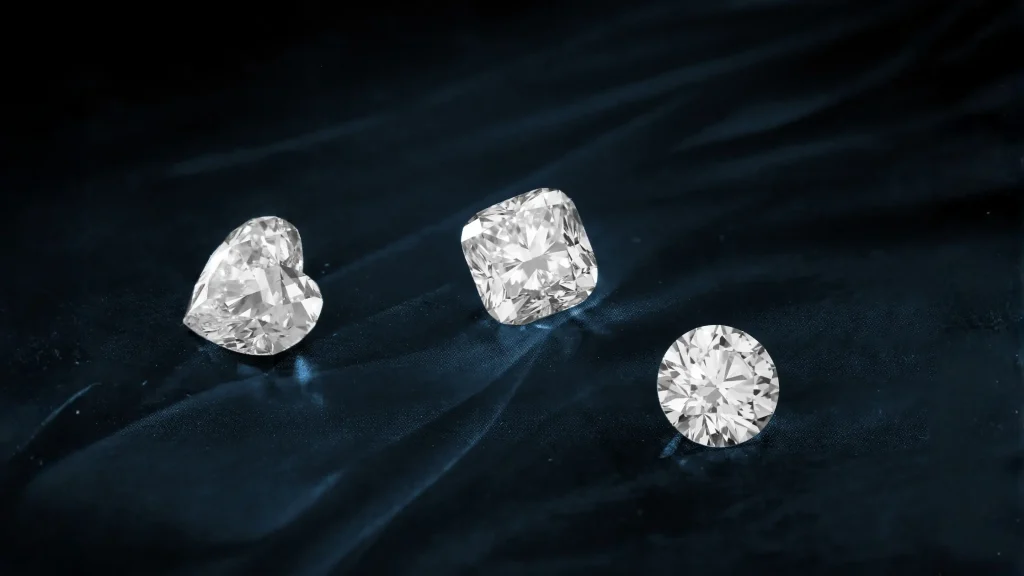
A jeweler’s loupe can’t distinguish between them. Nor can most skilled eyes. The only sure-fire technique to differentiate a lab grown from a mined diamond is with specialised equipment that can detect trace growth patterns not evident to the human eye. The same kind of equipment gemological labs such as IGI and GIA use when they grade a stone. The same 4Cs that determine the quality of a mined diamond apply exactly to lab grown diamonds: cut, colour, clarity and carat. A well-cut lab-grown diamond will have the same fire as a well-cut mined diamond because it is made from the same material, in the same method.
How Each One Actually Forms
Natural diamonds take billions of years to develop under 100 miles of pressure and heat deep in the Earth’s mantle. They get to the surface by volcanic eruptions. They are mined, chopped, and end up in a ring.
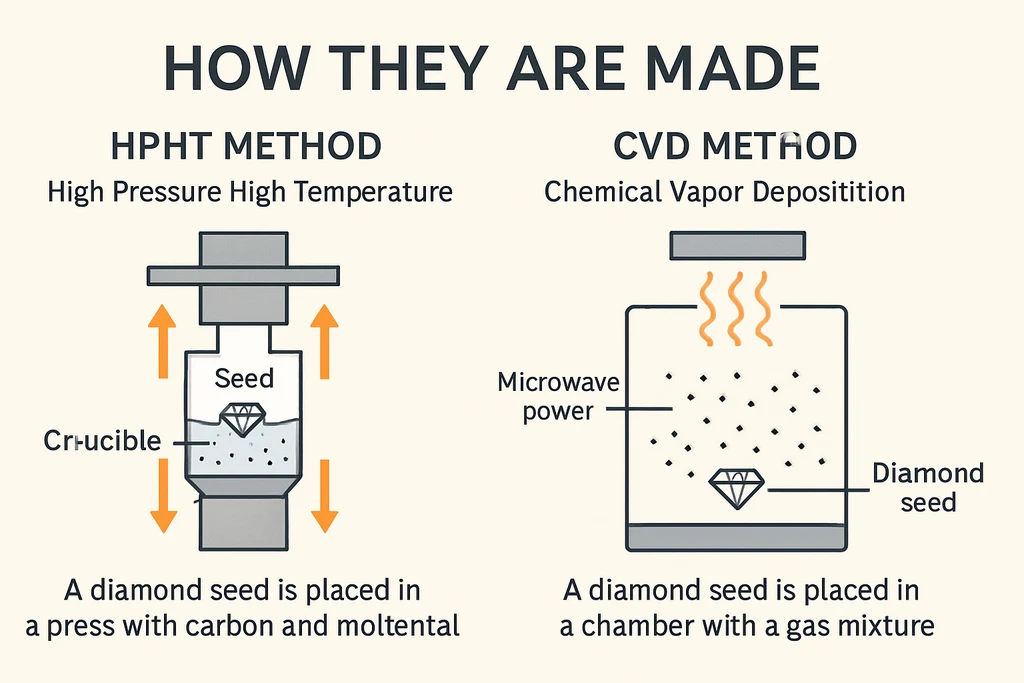
Lab grown diamonds form through one of two processes that recreate those same conditions in a controlled environment:
- HPHT (High Pressure High Temperature) industrial equipment mimics the natural earth pressure and heat process, producing a diamond from a tiny diamond seed.
- CVD (Chemical Vapour Deposition) builds up a diamond atom by atom in a carbon-rich gas chamber, layer by layer, to create the crystal.
Either way, what comes out is a real diamond crystal. It just took weeks or months instead of eons, and a lab instead of a volcanic pipe.
Where the Real Differences Actually Are
Most comparison articles skip over this point, so let’s be specific.
Origin and traceability. Natural diamonds have a geological past. A lab grown diamonds has a history of being manufactured. Neither is “fake”, they’re just distinct supply chains, and which one matters to you is a personal judgement, not an objective quality difference.
Price. This is the main one, and we address it in full below.
Resale market. And then there is the one honest trade-off that is worth calling out directly: the secondary market for natural diamonds is more mature, formed over more than a century of jewellery trade infrastructure. Lab grown diamonds are new to that market, and resale values are still finding their footing as acceptance develops. If resale value is a major priority (not simply quality or price), that’s a valid consideration. If you’re buying to wear and love, not as an investment vehicle, this matters a lot less, since neither natural nor lab grown diamonds are good investment assets as people frequently imagine.
Why Lab Grown Diamonds Cost 60–80% Less
This is a common first question, and it raises suspicion. If it’s the same stone, why is it so much cheaper?
The answer is not lower quality. Economics of supply. The price of a natural diamonds includes the expense of mining exploration, extraction, a global distribution system that often goes through many cutting and trading hubs, and decades of marketing that developed (and maintains) natural diamonds as a scarce luxury commodity. A lab grown diamonds avoids nearly all of that. It’s cultivated, chopped, and sold through a much shorter chain, with none of the cost of extraction and none of the premium of created scarcity.
As lab-grown production has scaled around the world, that cost disparity has widened, not closed. This is why a 2-carat lab grown diamonds can be around the same price as a 1-carat natural diamonds of the same cut and clarity grade. “That’s not a discount on quality. That’s the real cost of manufacture, with none of the century of marketing markup on top.
Are Lab Grown Diamonds a “Real” Diamond?
Short answer: Yes, in a physical form. A lab grown diamonds is a diamond, plain and simple, chemically and optically.
But here’s what you need to know, because it has a bearing on how all reputable retailers (including us) are required to describe these stones. The FTC’s Jewellery Guides say lab-grown diamonds must be described with a qualifying phrase like “laboratory-grown,” “lab-created” or similar terminology, in a “clear and conspicuous” manner every time they are advertised or sold. Absent that disclosure, retailers are not permitted to offer a lab-grown stone as merely a “diamond,” and words such as “real” or “genuine” cannot be used to describe it without that qualifier attached either.
That’s not to say quality is bad. It’s a consumer-protection rule to make sure purchasers always know exactly what they’re buying, mined or lab-grown. So when you see “lab grown diamonds” plainly listed on a listing, that’s the law doing its job, not a hedging about whether it’s a “real” stone. It is one matter. You just need to ask.
How You Verify Either One
Whether you buy natural or lab-grown, the process to authenticate your purchase is similar: an independent grading report from a reputable laboratory. The two most reputable labs to grade lab grown diamonds are IGI and GIA, and a report from either will outline the stone’s cut, colour, clarity, and carat weight and will certify its growth procedure.
Which One Should You Choose
There is no right solution here, simply one that matters more to you.
Lab-grown makes sense if: Budget efficiency is important, you desire a bigger stone or higher clarity grade for the same investment, or the traceability and smaller environmental footprint of a controlled production process matters to you.
Natural makes sense if: You expressly want a stone with a geological origin and a multi-generational reselling history, or if that story concerns you more than the price difference.
Neither is a downgrade. Two different gems. Two different stories. But same fire, in either case.
Ready to find your diamond?