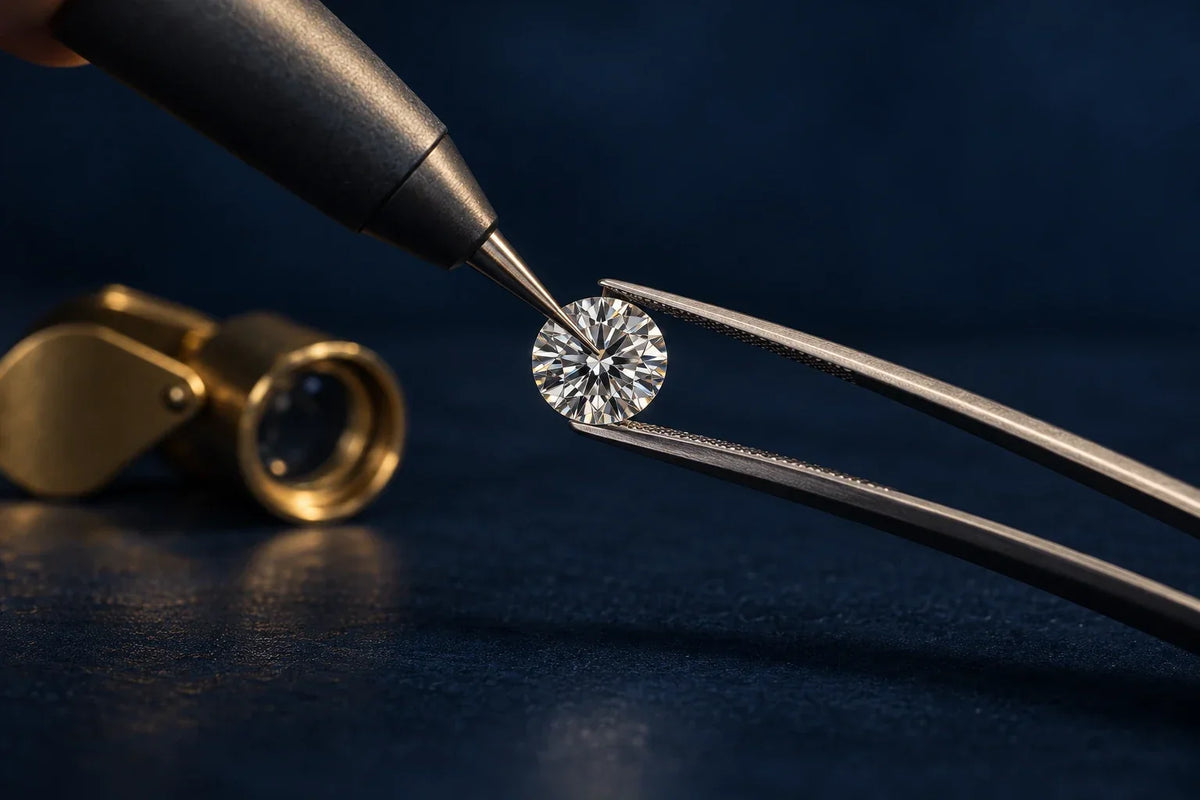
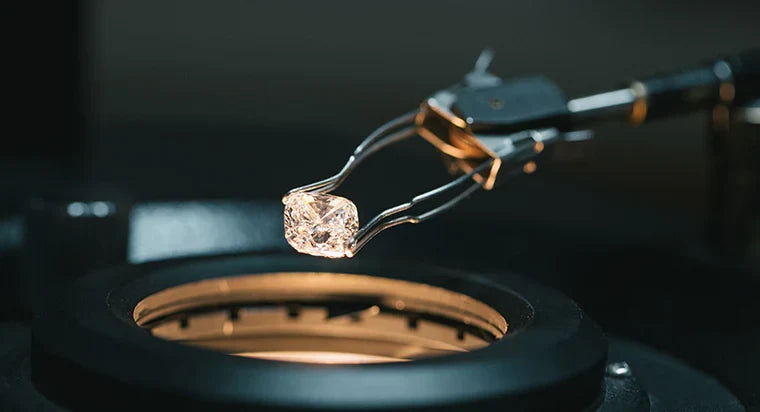
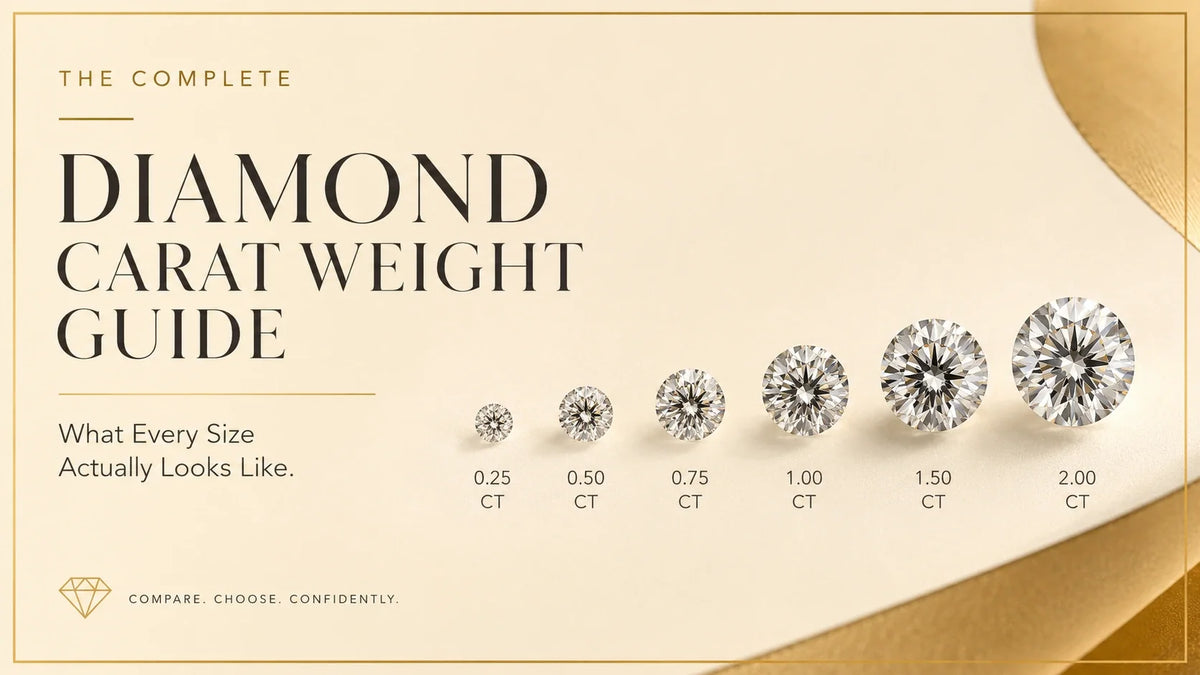
We cut lab grown diamonds in Surat, the city where most of the world's mined diamonds are cut and polished too. The wheels are the same and so are the people sitting at them. Put a finished lab grown stone next to a mined one on the bench and nobody in the room can tell you which is which by eye. That includes us.
So the short answer to "lab grown vs natural" is this: they are the same material with a different origin. The differences that do exist are price, resale value and how each one is identified, and those are exactly the things that should shape what you buy. This guide walks through all of them.
- Lab grown and natural diamonds are both pure carbon with the same hardness (10), the same refractive index (2.42) and the same sparkle.
- You can't tell them apart by eye, with a loupe or with a standard diamond tester. Gem labs use spectroscopy and UV imaging.
- For the same size and grades, a lab grown diamond costs a fraction of a mined one, and the gap widens as stones get bigger.
- Mined diamonds hold resale value better, though most still resell for well under what you paid.
- Always buy with an independent grading report and check the laser inscription matches it.
Lab grown vs natural diamonds: side by side
| Lab grown diamond | Natural (mined) diamond | |
|---|---|---|
| Material | Pure carbon, cubic crystal | Pure carbon, cubic crystal |
| Hardness (Mohs) | 10 | 10 |
| Refractive index | 2.42 | 2.42 |
| Time to form | A few weeks | Roughly 1 to 3 billion years |
| Where it forms | A press (HPHT) or a vacuum chamber (CVD) | About 150 km below the surface |
| Graded on the 4Cs | Yes, mainly by IGI and GIA | Yes, mainly by GIA |
| Visible difference | None | None |
| Passes a diamond tester | Yes | Yes |
| Price for the same size and grade | A fraction of mined | Much higher |
| Resale value | Low and still settling | Better, usually well below retail |
Are lab grown diamonds real diamonds?
Yes. A lab grown diamond is carbon atoms locked in the same crystal lattice as a mined diamond. It isn't a coating, a simulant or a "diamond-like" stone. Cubic zirconia and moissanite are different materials that only resemble diamond. A lab grown diamond is a diamond, and every physical and optical test treats it as one.
What changes is the label. In the US, the FTC's Jewelry Guides require a lab grown stone to be described with a clear qualifier such as "laboratory-grown" or "lab-created" whenever it is advertised or sold. The point of that rule is disclosure, so buyers always know the origin. It isn't a statement about quality. Every listing on our site says lab grown, and so does every grading report that comes with our stones.
If you want the long version, including what happens when someone puts one on a tester at a jewelry counter, read are lab grown diamonds real?
What makes them identical
Everything that makes a diamond look and wear like a diamond comes from its crystal structure, and that structure is the same whether it grew underground or in a lab.
- Hardness. Both score 10 on the Mohs scale, so they resist scratching better than any other gem you'll wear.
- Brilliance and fire. Both bend light the same way (a refractive index of 2.42), so a well-cut stone of either kind throws the same white flashes and the same flecks of color.
- Density and heat conduction. Identical. That is why handheld testers, which measure how heat or electricity moves through the stone, can't separate them.
- Grading. Both are graded on the same 4Cs: cut, color, clarity and carat. A G color, VS1 lab grown diamond looks like a G color, VS1 mined one.
The one thing that decides how a diamond actually looks on a hand is the cut. A badly cut mined diamond looks dull next to a well-cut lab stone, and the reverse is just as true. Our 4Cs guide explains which grades are worth paying for.
How each one forms
Natural diamonds
A natural diamond formed roughly 150 kilometers (about 90 miles) below the surface, where heat and pressure turned carbon into a crystal over an enormous stretch of time. Most are between one and three billion years old. Deep volcanic eruptions carried some of them up inside a rock called kimberlite, and that rock is what diamond mines dig out today.
Lab grown diamonds
A lab grown diamond starts from a thin slice of existing diamond, called a seed, and grows on it in one of two ways.
- HPHT (high pressure, high temperature). A large press recreates conditions in the mantle: around 50,000 times normal air pressure and temperatures above 1,300°C. Carbon dissolves in molten metal and crystallizes onto the seed.
- CVD (chemical vapor deposition). A mix of methane and hydrogen is energized into a glowing plasma inside a low-pressure chamber. Carbon atoms separate from the gas and settle onto the seed, building the crystal layer by layer over several weeks.
Some CVD diamonds are given a short heat treatment after growth to improve their color. That's a normal step, and the grading report will say whether a stone is "as grown" or treated. Both methods produce a true diamond, and once a stone is cut you can't tell HPHT from CVD by eye. If you're curious which suits you, we compare them in HPHT vs CVD.
Can anyone tell the difference?
Not by looking, and not with a jeweler's loupe. Standard diamond testers pass lab grown diamonds too, because they test the very properties the two share.
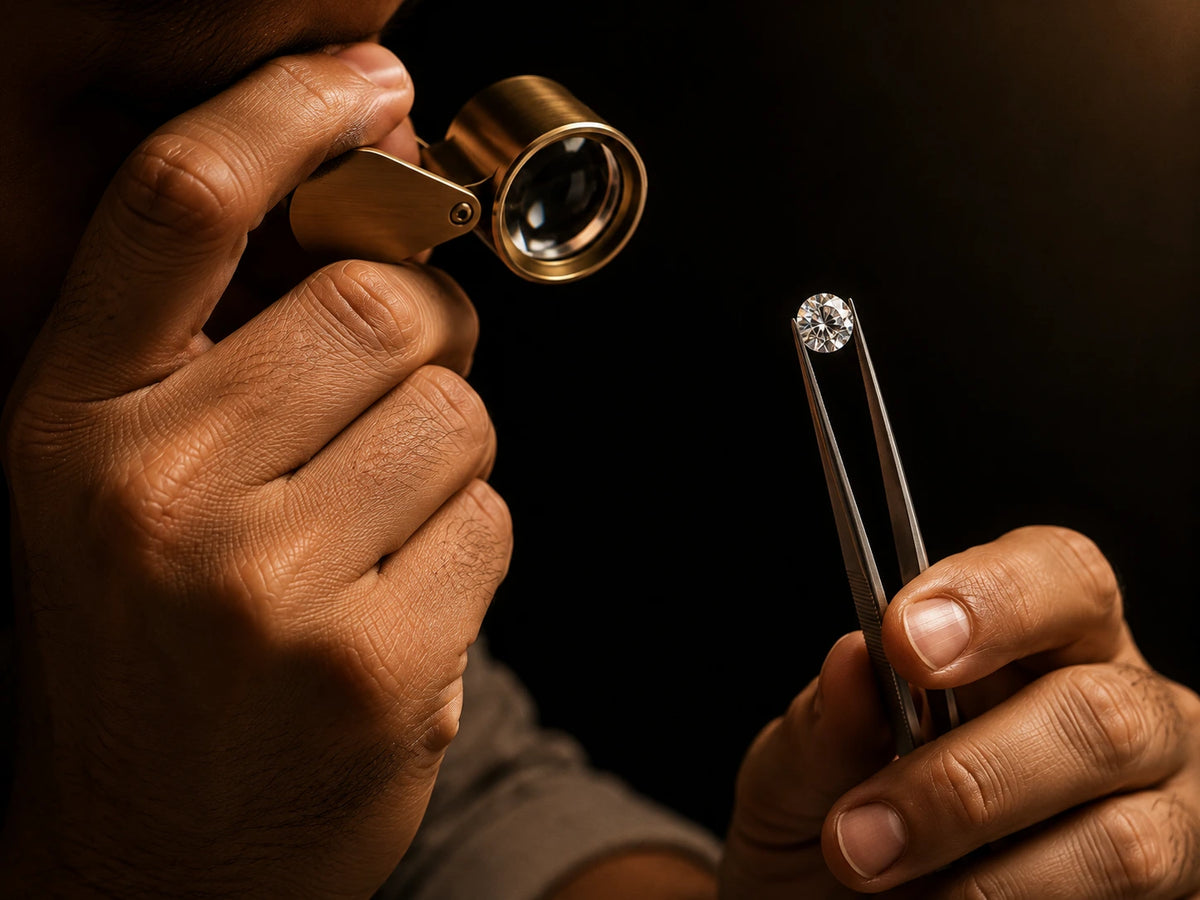
Gem labs can tell, because the two grow under very different conditions and keep a record of it inside the crystal:
- Nitrogen. Most mined diamonds contain traces of nitrogen. Most lab grown diamonds contain almost none, which puts them in a rare category called Type IIa. Only a small percentage of mined diamonds are Type IIa.
- Growth patterns. Under strong ultraviolet light, HPHT and CVD stones show distinctive growth structures that natural diamonds don't.
- Spectroscopy. Lab instruments read how the stone absorbs light and pick up tiny atomic signatures from each growth process.
None of this equipment sits behind a normal jewelry counter. That is why the paperwork matters so much.
How we handle it: every lab grown diamond we sell is graded by IGI and laser inscribed on its girdle, the thin outer edge, with its report number. You can't see the inscription without magnification, but any jeweler can read it with a loupe, and you can enter the number on IGI's website to confirm the stone's grades and origin.
Is one better quality than the other?
Neither origin is better by definition. Quality depends on the individual stone: its cut, color and clarity.
In practice, lab grown diamonds on the market tend to come in higher color and clarity grades, because growers can control conditions and cutters can afford to cut for beauty rather than to save every point of weight. Near-colorless and VS clarity are common in lab grown. In mined stones the same grades cost a great deal more.
Lab grown stones have their own quirks to look out for. Some CVD diamonds can show a faint brown or gray tint, and some HPHT diamonds have small metallic inclusions from the growth process. Both show up on a grading report and in good photos, which is why we photograph every stone and check it against its report under a loupe before it goes on the site.
The price difference, and why it exists
This is the part most people come for. For the same carat, color, clarity and cut, a lab grown diamond costs a fraction of a mined one. The gap gets wider as stones get bigger, because large mined diamonds are genuinely rare and lab grown ones aren't.
In real terms, a budget that buys a good 1 carat mined diamond can often stretch to a 2 or even 3 carat lab grown diamond of similar grades. Or you can keep the size and put the difference into the setting.
The lower price isn't a sign of a lesser product. The cost of a mined diamond carries exploration, extraction and a long chain of dealers before it reaches a shop window, plus a century of marketing built around scarcity. A lab grown diamond skips most of that, and as growing technology has improved and production has increased, prices have kept falling.
We cut, grade and sell from Surat with no wholesaler in between, which removes a few more layers. For current figures by carat and shape, see our lab grown diamond price guide, or use the price estimator to set a budget before you browse.
Resale value: the honest trade-off
If you might sell the diamond one day, this is the strongest argument for mined.
Mined diamonds have a long-established secondary market. Even so, most resell for well under their retail price, often less than half, because dealers buy at wholesale. Lab grown diamonds have a much thinner resale market, and since new lab stones keep getting cheaper, a used one is worth little.
Most people don't buy an engagement ring or a pair of studs planning to sell it. If you're buying to wear, the better question is how much diamond you get for your money, and that's where lab grown wins clearly. We cover this in more depth in the price and resale guide.
Ethics and environment
A lab grown diamond has a short, traceable path: grown, cut, graded, sold. That removes the risk of conflict diamonds completely.
The environmental picture is more mixed than most marketing admits. Growing a diamond uses a lot of electricity, so its footprint depends heavily on where that power comes from. Mining moves huge amounts of earth and uses fuel and water. We set out both sides, without the spin, in are lab grown diamonds ethical?
How to check what you're buying
The checks are the same whichever kind of diamond you choose:
- Ask for an independent grading report. For lab grown diamonds, IGI and GIA are the names you'll see most. Our guide to IGI vs GIA explains how they differ.
- Look up the report number on the lab's website and make sure it matches the stone: same weight, same measurements, same grades.
- Check the inscription. The number on the girdle should match the report.
- Ask for real photos or video of that exact stone, not a stock image. Two diamonds with identical grades can look quite different in light.
- Read the return policy before you pay, so you can check the stone in person without risk.
Which should you choose?
Choose a lab grown diamond if you want the most size and quality for your budget, you'd rather spend the difference on the setting or on something else entirely, or a short, traceable supply chain matters to you.
Choose a natural diamond if a stone that formed over a billion years is part of what you're buying, or if possible resale value is a priority.
Neither is a compromise on beauty. If you're leaning lab grown, you can browse every loose stone we have by shape, carat and grade, or look at our colored lab grown diamonds. In pinks and blues the price difference from natural is even more dramatic. And if you'd like a second opinion on a stone, ask us. A real person in Surat will answer.
Lab grown vs natural diamond FAQs
Do lab grown diamonds get cloudy or change color over time?
No. A lab grown diamond is as stable as a mined one. Any diamond can look dull when it's dirty, because skin oil and lotion cling to the surface. Warm water, a drop of mild soap and a soft brush bring it straight back.
Will a jeweler know my diamond is lab grown?
Only if they read the girdle inscription or send the stone to a lab. They can't tell by looking or with a standard tester.
Is a lab grown diamond the same as moissanite?
No. Moissanite is silicon carbide, a different material with more rainbow fire and a slightly lower hardness. Cubic zirconia is softer again. See lab grown diamond vs moissanite for a full comparison.
Do lab grown diamonds last forever?
They're exactly as durable as mined diamonds. A hard knock at the wrong angle can still chip any diamond, so pointed shapes such as pears and marquises are best set with a protective prong at the tip.
Why are lab grown diamonds so much cheaper if they're the same?
Because the cost of mining, a long trading chain and decades of scarcity marketing aren't part of the price. Growing capacity has also expanded quickly, which keeps pushing prices down.
Are lab grown diamonds worth it?
If you're buying to wear and enjoy, we think so: you get the same stone for far less money. If you're buying something to hold its value, neither kind of diamond is a good investment.
Can I insure a lab grown diamond?
Yes. Insurers cover lab grown diamonds the same way they cover mined ones. Your grading report and purchase receipt are usually all they need.