It's the first question almost everyone asks us, usually in a slightly lowered voice: "But is it a real diamond?" Fair enough. If you're spending real money, you want to know you're not buying a very good imitation.
The answer is yes. A lab grown diamond is a real diamond. It is made of the same thing, behaves the same way and is graded by the same labs as a diamond dug out of the ground. What it isn't is a mined diamond, and that distinction matters for price, resale and how it's labeled. Below we go through what "real" actually means, what happens on a diamond tester, how professionals tell the two apart, and how to check the stone you're buying.
- Lab grown diamonds are real diamonds: pure carbon in the same crystal structure as mined diamonds.
- They are not simulants. Cubic zirconia, moissanite and white sapphire are different materials that only look similar.
- Lab grown diamonds pass standard diamond testers. Only specialist screening devices and gem labs can identify them.
- By law in the US, they must be sold with a clear label such as "lab grown" or "laboratory-created".
- The proof is the grading report and the laser inscription on the stone. Check both.
What "real" means for a diamond
A diamond is defined by what it's made of and how its atoms are arranged, not by where it came from. A diamond is carbon, and only carbon, locked into a rigid cubic crystal. That arrangement is what gives diamond its hardness, its sparkle and its ability to carry heat away faster than almost anything else.
A lab grown diamond has exactly that composition and that structure. Its properties line up with a mined diamond on every measure that matters:
| Property | Lab grown diamond | Mined diamond |
|---|---|---|
| Chemical makeup | Carbon (C) | Carbon (C) |
| Crystal structure | Cubic | Cubic |
| Hardness (Mohs) | 10 | 10 |
| Refractive index | 2.42 | 2.42 |
| Specific gravity | 3.52 | 3.52 |
| Thermal conductivity | Very high | Very high |
So when people ask whether a lab grown diamond is "real", the honest scientific answer is that there's nothing about it to make it not real. The difference is its origin: one grew in the earth over a billion years, the other grew on a diamond seed over a few weeks. We explain both processes, and everything else that differs, in lab grown vs natural diamonds.
Lab grown vs "fake" diamonds
The confusion usually comes from mixing up lab grown diamonds with diamond simulants. A simulant is a different material chosen because it looks a bit like diamond. A lab grown diamond isn't imitating anything.
| Stone | What it is | Hardness | Is it a diamond? |
|---|---|---|---|
| Lab grown diamond | Carbon crystal grown on a diamond seed | 10 | Yes |
| Mined diamond | Carbon crystal formed in the earth | 10 | Yes |
| Moissanite | Silicon carbide | 9.25 | No |
| White sapphire | Aluminum oxide | 9 | No |
| Cubic zirconia | Zirconium dioxide | 8 to 8.5 | No |
| Glass or crystal | Silica-based glass | About 5.5 | No |
You can often spot a simulant with practice. Cubic zirconia scratches and clouds over with years of wear. Moissanite throws strong rainbow flashes and shows doubled facet edges when you look through it at an angle. A lab grown diamond does none of that, because it's diamond. For a full comparison, see lab grown diamond vs moissanite.
Will a lab grown diamond pass a diamond tester?
Yes. The common handheld tester you'll see at a jewelry counter or pawn shop is a thermal tester. It touches the stone with a heated tip and measures how quickly the heat is carried away. Diamond conducts heat extremely well, so the tester beeps. Lab grown diamond conducts heat just as well, so it beeps too.
Some testers also measure electrical conductivity, mainly to catch moissanite, which conducts electricity while most diamonds don't. Here's the twist: a small number of lab grown diamonds, usually blue-tinted HPHT stones that contain a trace of boron, conduct electricity as well. On a cheap multi-tester they can be flagged as "moissanite" even though they're diamond. Some rare natural blue diamonds do the same thing. It's one more reason a handheld tester is a quick screen, not proof.
What a standard tester can never do is tell you whether a diamond is lab grown or mined. For that you need either a dedicated screening device or a gem lab.
Can a jeweler tell a lab grown diamond from a mined one?
Not by eye and not with a loupe. A jeweler looking at a well-cut lab grown diamond sees the same brilliance, the same kinds of inclusions and the same facet pattern they'd see in a mined stone.
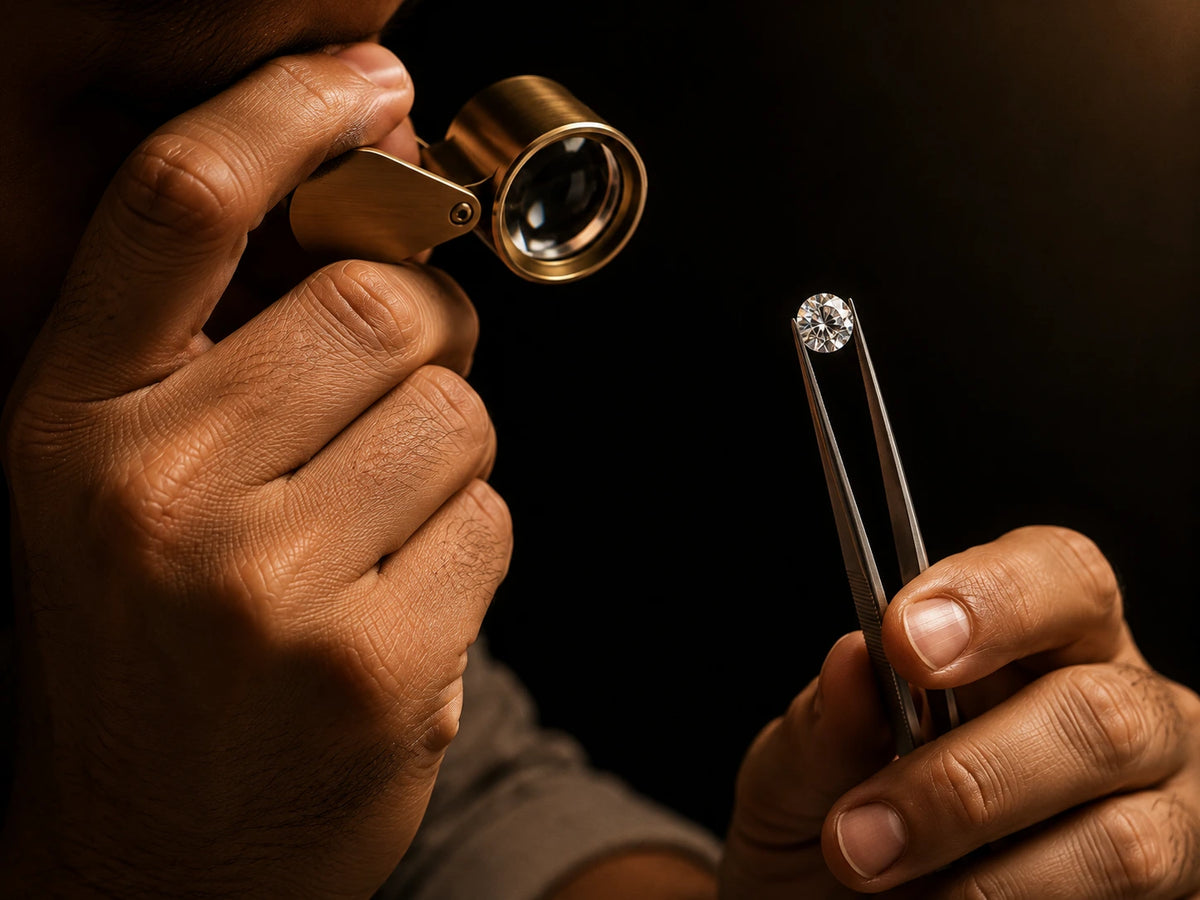
A jeweler can tell in two ways:
- By reading the inscription. Lab grown diamonds graded by IGI carry a tiny laser inscription on the girdle with the report number. Any jeweler with a loupe can read it.
- By using a screening device. Larger jewelers and labs use machines built to sort mined from lab grown diamonds, such as GIA's iD100 or De Beers' SynthDetect. These look at how the stone responds to ultraviolet light and flag anything that needs a closer look.
A small independent jeweler without one of these devices will usually send a stone to a lab if they need certainty.
How gem labs identify lab grown diamonds
Labs can tell because mined and lab grown diamonds grow under very different conditions, and the crystal keeps a record of it.
- Nitrogen content. Most mined diamonds contain measurable nitrogen. Most lab grown diamonds contain almost none, which puts them in a group called Type IIa. Only a small share of mined diamonds are Type IIa, so a IIa result is a prompt for further testing.
- Growth structure. Under intense ultraviolet light, HPHT diamonds often show a cross-shaped or cube-shaped growth pattern, and CVD diamonds show fine parallel growth layers. Mined diamonds show neither.
- Spectroscopy. Labs measure exactly which wavelengths of light a stone absorbs or emits. Each growth process leaves tiny atomic defects with their own fingerprint.
- Inclusions. HPHT stones sometimes contain small metallic inclusions from the molten metal used to grow them. Mined diamonds don't.
When IGI or GIA grades a lab grown diamond, the report states clearly that it is laboratory-grown, names the growth method (HPHT or CVD) and notes whether the stone was treated after growth. That's why choosing a well-known lab matters.
Why lab grown diamonds are labeled differently
If they're real diamonds, why can't they simply be sold as "diamonds"? Because buyers have a right to know the origin, and the price difference is large.
In the US, the FTC's Jewelry Guides require a lab grown diamond to be described with a clear qualifier such as "laboratory-grown", "laboratory-created" or "[manufacturer name]-created" whenever it's advertised or sold. Other countries have similar consumer rules. The label isn't a warning about quality. It's there so nobody pays a mined-diamond price for a lab grown stone, or the other way round.
Any seller who's vague about origin, or who describes a lab stone in a way that implies it was mined, is doing something they shouldn't. On our site every listing, every invoice and every grading report says lab grown.
How to verify your lab grown diamond
Whether you buy from us or anyone else, these five checks take ten minutes and tell you exactly what you have.
- Get the grading report. A lab grown diamond worth buying comes with a report from an independent lab such as IGI or GIA. Be wary of reports from labs you can't find any information about.
- Look the report up online. Enter the report number on the lab's website. The digital record should match the paper or PDF you were given.
- Match the measurements. The report lists the stone's carat weight and its measurements to a hundredth of a millimeter. A jeweler can measure the stone and confirm they match.
- Read the inscription. Ask a jeweler to read the girdle inscription under a loupe. The number should match the report.
- Look at real images. Buy from a seller who shows photos and video of the actual stone, so what arrives is what you chose.
What we do before a stone is listed: every diamond on our site is graded by IGI and laser inscribed with its report number. We check each one against its report in person, under a loupe, and photograph it on our bench in Surat. If a stone doesn't match its certificate, it doesn't go on the site.
Common myths about lab grown diamonds
"Lab grown diamonds are just cubic zirconia."
No. Cubic zirconia is a different material with a different hardness and a different look over time. A lab grown diamond is diamond.
"They'll go cloudy or yellow after a few years."
No. A lab grown diamond is chemically stable, the same as a mined one. A dirty diamond of either kind looks dull until it's cleaned.
"A diamond tester will expose them."
It won't. Standard testers confirm a lab grown diamond is diamond. Only specialist screening devices and gem labs can determine origin.
"Lab grown means lower quality."
Quality comes from the individual stone's cut, color and clarity, not its origin. Lab grown diamonds are often available in higher grades because the growing conditions are controlled. Our 4Cs guide explains what to look for.
"They're not 'natural', so they're not real."
"Natural" describes where a diamond came from, not whether it's a diamond. A lab grown diamond isn't natural, and it is real.
So, should you buy one?
If you want a real diamond and you'd rather put your budget into size, quality or the setting than into the cost of mining, a lab grown diamond is a sensible choice. Buy one with a proper grading report, check the inscription, and you'll know exactly what you own.
You can browse our loose lab grown diamonds by shape, carat and grade, each shown with its IGI report and real photos. If you're working to a budget, our price guide shows what each size costs. And if you want someone to look at a stone with you, ask us.
Are lab grown diamonds real? FAQs
Is a lab grown diamond a real diamond or a fake?
It's a real diamond. "Fake" diamonds are simulants such as cubic zirconia or glass, which are different materials.
Does a lab grown diamond test as real on a diamond tester?
Yes. It passes a thermal diamond tester just like a mined diamond. A small number of boron-containing lab stones can confuse electrical testers, which is why a lab report is the real proof.
Can a pawn shop or jeweler tell it's lab grown?
Not by looking. They'd need to read the laser inscription, use a screening device or send the stone to a lab.
Do lab grown diamonds sparkle like mined diamonds?
Yes. Sparkle depends on the material and the cut, and the material is identical. A well-cut lab grown diamond sparkles exactly like a well-cut mined one.
Are lab grown diamonds worth anything?
They have real value as jewelry, but resale value is low and still settling, so they're best bought to wear rather than as an investment. We explain why in our price and resale guide.
What is a lab grown diamond called?
You'll see "lab grown", "lab created", "laboratory-grown", "man-made" and "cultured" diamond. They all mean the same thing. "Synthetic diamond" is the older technical term, and it still means a real diamond, not a fake one.